Guide
What to Wear to a Tech Interview Without Looking Too Stiff (From Clothes You Already Own)
For a tech interview, aim for smart casual dressed one notch above everyday casual — not a full corporate suit. You can't reliably know what a specific team wears, so don't try to; work from the safe industry baseline instead. Build it from clothes you own: a blazer over a clean knit or collared shirt, with tailored trousers and simple leather shoes — dark clean denim and minimal sneakers only if the company type is clearly more casual. That reads as prepared and easy to work with, without looking like you wandered in from a different industry.
Who this is for
You've got a tech interview — startup, scale-up, or a big tech team — and you're caught between "don't underdress" and "don't look stiff and out of touch." You don't want to buy an interview outfit, and you can't see inside the office to know their norm. This is about landing on a confident, safe default from your existing closet.
Why "one notch above casual" beats a suit — and why you shouldn't research the team
Two instincts steer people wrong here. The first is defaulting to a full suit and tie, which in most tech settings reads as formal to the point of mismatch. The second is trying to research exactly what the team wears — combing LinkedIn photos or the careers page to reverse-engineer a dress code. That's unreliable: a handful of photos don't tell you the daily norm, they're often posed or dated, and you'll talk yourself into over- or under-dressing on thin evidence.
The steadier move is to skip the guessing and dress to the industry's well-established baseline. Tech skews smart casual. Land one clean notch above everyday casual and you're appropriate almost everywhere, without needing to know a single face in the room.
The method: dress to the baseline, one notch up
- Start from the tech baseline. Assume smart casual unless you've been explicitly told otherwise. This is the safe center of gravity for the whole industry.
- Go one notch above everyday casual — not toward corporate. The goal is "put-together version of a normal workday," not "wedding" or "boardroom." One notch is enough to signal you took it seriously.
- Soften any structure you add. If you want the authority of a jacket, use a blazer over a fine knit or a clean collared shirt — skip the tie. Structure plus a relaxed layer under it reads capable, not rigid.
- Build entirely from what you own. Tailored trousers (or dark, clean denim if the company type is casual); a knit, an untucked-but-neat shirt, or a smart tee under the blazer; simple leather shoes as the default — minimal clean sneakers only as a half-notch relax for early-stage or engineering-heavy teams. No new purchase required.
- Nudge half a notch for context, without researching people. Fintech, enterprise sales, or a client-facing role — lean slightly sharper (leather shoes over sneakers). Early-stage startup or a hands-on engineering team — you can relax the layer. You're adjusting to the type of company, not decoding a specific team.
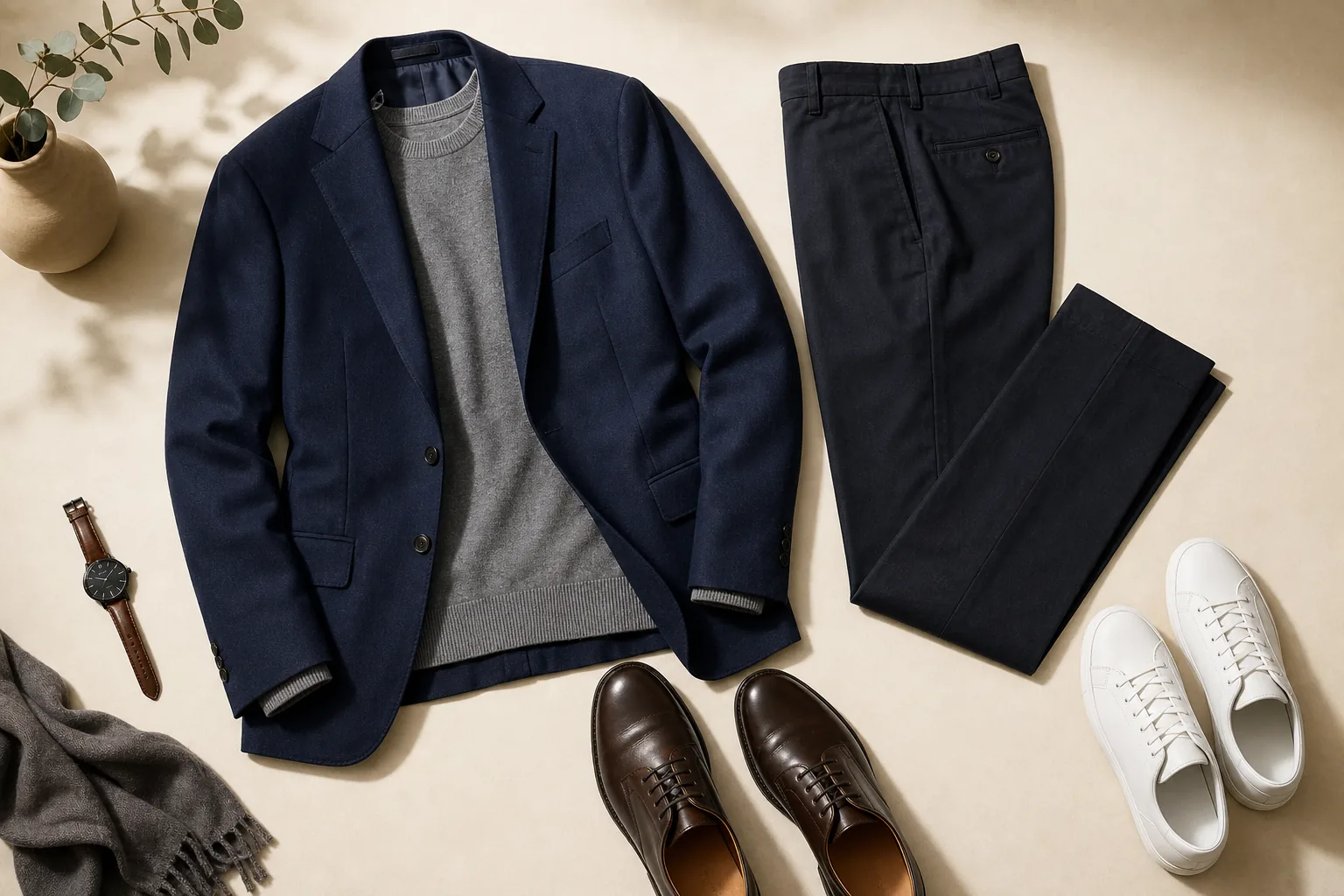
Example from a real-style closet
Daniel owns exactly one suit and his instinct is to wear the whole thing. Instead he runs the baseline. He keeps the suit's navy blazer, drops the matching trousers and the tie, and pairs the blazer with a fine-gauge grey knit and dark, clean chinos he already owns. On his feet: simple leather shoes would be the default; he chooses minimal white leather sneakers as a half-notch relax for an early-stage team. It's one notch above his normal Friday, softened by the knit, and built with zero new spend. He walks in looking like someone who'd fit the team on day one — not someone interviewing for a bank.
Common mistakes
- Wearing a full matching suit and tie when smart casual is the industry norm.
- Reverse-engineering a dress code from a few LinkedIn photos and over-correcting in either direction.
- Going too casual — a graphic tee and worn sneakers can read as not taking it seriously.
- Buying a new "interview outfit" you'll never wear again instead of styling what you own.
- Adding a blazer but keeping it stiff with a tie and dress shirt, so it fights the relaxed tech setting.
Where an AI wardrobe app helps
Once your closet is uploaded, anchor the blazer you want to interview in and let Mysta style the rest around it. Because Style DNA already knows your silhouettes, colors, and formality, it builds the knit, trousers, and shoes to match — so the outfit reads as your put-together self rather than a costume, and you walk in without second-guessing the fit or the formality level.
Limitations
Some roles and companies do expect formal dress — client-facing finance, certain consulting-adjacent tech, or a company that explicitly tells you to suit up. Follow explicit instructions over any general baseline. If a recruiter gives you a specific dress code, that beats this framework every time. And a nearly empty closet is a real constraint — but confirm the gap against the baseline before shopping, not on nerves alone.
Quick checklist
- Assumed smart casual as the tech baseline
- Aimed one notch above everyday casual, not toward a suit
- Softened any jacket with a knit or open collar — no tie
- Built the outfit entirely from clothes I own
- Adjusted half a notch for company type, not for specific people
- Confirmed it still looks and feels like me
Frequently asked questions
Should I wear a suit to a tech interview?
Usually not a full suit. Most tech teams run smart casual, so a suit and tie can read as formal and out of step. If you want the authority of tailoring, wear the blazer alone over a knit or open collar and skip the tie — unless a recruiter has told you the dress code is formal.
What do I wear to a remote or video interview?
Dress the top half exactly as you would in person — a blazer over a clean knit or collared shirt in a solid, mid-tone color reads well on camera. Keep patterns simple so they don't distract on video, and still put on real trousers in case you stand up.
Is it bad to be overdressed for an interview?
Mild overdressing rarely hurts and can signal you care, but a full suit in a very casual tech office can read as a mismatch. Aiming one notch above the smart-casual baseline keeps you safely on the 'took it seriously' side without tipping into stiff.
Try it before interview day
Before interview day, pull one blazer, one knit, and one pair of tailored trousers you already own and try the combination — that's your outfit, no shopping trip required. If you'd like to see it styled on you and tuned to how you actually dress, Mysta can build it from your closet.